Mar 30, 2010

Cekodok Pisang

Cekodok...Cekodok


Some call it cekodok pisang, kuih kodok (toad-like kuih?) or jemput jemput, but nevertheless the basis of this sweet tea time snack is the same. It must have banana and flour. The banana especially the too-ripen batch to eat on its own have to be mashed, adding in sugar and a bit of salt to taste. To make it easier for the cook to make the dough into ball-like shape, wheat flour is added. The ball of mashed banana will then be deep fried in hot oil.

I hate cekodok pisang sold outside as the cekodok tend to have too much flour and have only a little banana. Sometimes you can’t even taste the mashed banana inside. I can understand that the sellers want to save cost but it’s frustrating for choosy eater like me.
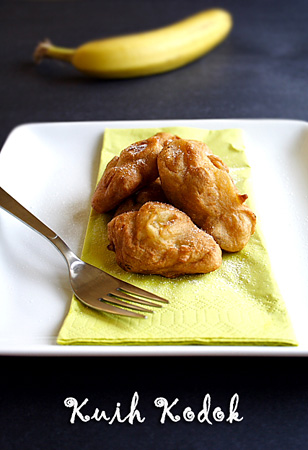

I usually make my own cekodok pisang using pisang emas. I am not sure what other type of banana that can be used as substitute. Mine usually has less flour and more banana, making it very soft and mushy which could last for hours without turning hard like a rock when it’s cold.

Categories:

Tapai Pulut

Fermented Glutinous Rice


This is my first time ever making my own tapai pulut or also known as fermented glutinous rice.
Thanks to Gertrude for showing me the ragi at the asian store near her house. It cost me only $0.67 for 2 balls of ragi.

The tapai is so sweet and juicy. I chilled it in the fridge before I eat.


Some people eat this tapai pulut with other sweet delights like cendol, as tapai drink or with grated coconut. For me, I like the tapai just as it is.


The first step I did in this tapai process was to soak the glutinous rice for a few hours. Then I wash and toss the rice.

On the stove, I line up banana leaves in my steamer.


I like the rice on a crunchy side so, occasionally I ran water over the rice and let it drip. I steamed the rice until half cooked.

Then I let the cooked glutinous rice to cool down at room temperature before I sprinkle it with ragi evenly. I use 2 balls of ragi on 2 cups of uncooked glutinous rice.

I then put the rice in a close container.

Then I wrap the container with a clean towel and keep it away for 2 days. The reason for the towel wrap or any cloth wrap is to keep the tapai warm. I open the wrap on the 3rd day and keep the tapai in the fridge. Again, I must say it, this tapai is very sweet.

The glutinous rice that has been fermented for 2 to 3 days is ready to be wrapped in banana leaves for sweeter fragrants and presentation before serving.

Categories:

Pulut Durian

Durian Oh Durian!

[Pulut+Durian.jpg]


Durian again!! When a Malaysian married with a Japanese... born this sweet "sushi". Pulut durian (akaserawa durian) is actually one type of traditional Malaysian desserts -steamed glutinous rice served with fresh durian and coconut milk. Some people would have it with brown sugar syrup, but I had mine with 100% pure maple syrup... luxury!

Durian has a big family, and different species have different colour, texture and taste. You can see that even the shell is different, if you are a durian expert (I am not!!). Light yellow colour durian (in the photo) tasted sweeter than the other one. Or... maybe I should say it carries no liquor-like bitter taste that some durians have.

Recipe for the glutinous rice layer as follows (updated on 4 Dec 2009):
Ingredients (10-12 pcs):
1 cup glutinous rice, soaked for 3-4 hours
¾ cup water
¼ cup coconut milk
Pinch of salt

Directions:
  1. Drain the glutinous rice. Bring together rice, water and salt in a baking pan.
  2. Steam glutinous rice in a preheated steamer, over medium heat for about 15 minutes.
  3. Add in coconut milk and gently stir with a spatula to mix. Continue to steam for another 10 minutes.
  4. Turn the heat off, and leave the steamed glutinous rice in the steamer for 5 minutes or so.
  5. Set aside to cool. Then, shape into desired shape and top with durian or other fruits like mango and peach.
  6. Note: If stronger coconut taste is desired, adjust the ratio of coconut milk and water.

Categories:

Mar 29, 2010

Ais Kacang

On a recent trip to Singapore I fell hopelessly in love with the unholy, neon-colored love child of a Sno-Cone and a Jell-O salad, also known as the ais kacang. The ais kacang is wildly popular in Singapore and Malaysia (where it's sometimes called an "ABC"), served in outdoor food centers and in mall food courts countrywide. In its most basic iteration, it consists of a scoop of roughly shaved ice drizzled with varicolored sugar syrups and evaporated or condensed milk sitting on a nest of corn kernels, red beans and cubes of herb jelly or gluey sago pearls. It's the hyperstimulating carnival of desserts, with every texture -- Crunchy! Chewy! Icy! Glutinous! Creamy! -- and dozens of flavors exploding in your mouth all at once. Some versions even include a scoop of ice cream or a pile of fresh mango or (eeek!) durian. More is more, right?


[AisKacang2.jpg]
Never mind that it's still 45 degrees and raining here; I've been craving ais kacang as if it's midsummer in Southeast Asia. So I decided to make my own. I simply ground up ice in my food processor and doused it with Torani raspberry syrup (the kind you use to make Italian soda) and a milk syrup I'd made by cooking evaporated milk with brown sugar. I omitted the corn and beans, but next time I'll try adding some sago pearls or chopped fresh berries.

Categories:

Petai...petaii....petaiiii


Stir-fry Sambal Shrimp with Petai /Sator Beans (Stinky Beans)

Petai or Sator Beans or Stinky Beans is one of many Asian favourite beans which you can find everywhere in Malaysia,Indonesia,and Thailand.If you 're not use to eat this Stinky Beans ,it's can be really challenging.

Don't mistaken Sator beans from Broad beans or Lima beans.This beans have a very strong pungent or unique flavor after you consume it but don't worried in the other bright side you can benefit good source of vitamin A, calcium and phosphate from it. 

Anyway,in US we can't get petai or sator beans in pods,but we're lucky enough we can get it in frozen form at any Asian market in New York City. While I was cleaning my chest freezer,I found 2 small packs of petai sitting at the bottom of my freezer. I'm in the mood for stinky beans ,since it's been awhile I eat it at home.


Ingredients:
8 oz Fresh Sator Beans/Petai
10 pc shrimp (clean and deviened) tail intact*optional*
1 tbsp sugar
1 tsp salt
1 tsp tamarind powder
1-2 red chili (cut)
1 tbsp oil

Method:
1:Heat skillet with oil at high heat,add in sambal belacan and shrimp.Stir-fry for 30 second or until the shrimp curl,then quicly add in petai/sator beans and seasoning.
2:Sauteed for 1 minutes or lesser,then removed from heat.Taste the seasoning before dish out.Serve warm with rice.

Categories:

Laksa Janggus!

img_6646


Laksa Janggus, Kampung Perlis, Balik Pulau
Yum yum yum! Balik Pulau is particularly famous of two things. It’s name is synonymous with its well known Durians and secondly, Laksa!
There are a few stalls scattered around this little township offering this yummy mouth watering delicacy.
Well, for this time, I would like to blog about Laksa Janggus.
Note that Laksa Janggus is different from Siam Laksa as it’s more to sour/spicy/lemak. Sorry I’m not too good in describing food. It’s a laksa that Malays usually sell, hopefully you get my idea.

“Featured in myBalikPulau

Laksa Janggus stall
Laksa Janggus, self-service concept to serve large crowd
Arguably the first self-service stall in Balik Pulau. It’s to cater to large patrons visiting this stall even at weekdays!
Aside laksa, there are kuihs for sales too
Well, beside Laksa, they do offer delicious Fried Pisang and some other kuihs as well. Some people are here just to sought after this kuihs.
The crowd
Laksa Janggus, Kampung Perlis, Balik Pulau
How to get there?
I’ll assume you know how to find your way to Balik Pulau town. From the roundabout, go straight all the way (you will see Maybank on your right and Shell station just after that). Drive for 3km, you will see MARA on your left. Take the right turning just after you spotted MARA. Drive a little bit to the front, you will reach a cross junction, take left. Drive for another 3.5km then you will see a mosque at a T-junction. Take right. It’s located just 300m after the turning on the right.
You can’t miss it as there’s always large pool of cars parked around the stall! Try it!

Categories:

Mar 28, 2010

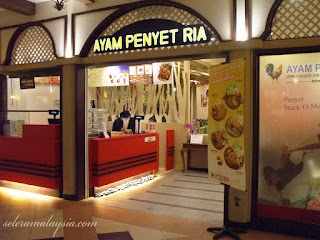
Ayam Penyet Ria,

 Sunway Pyramid


Ayam PenyetAyam Penyet Ria

The authentic Indonesian restaurant Ayam Penyet Ria is now available in Sunway Pyramid, Subang Jaya, Malaysia. Ayam Penyet or Smashed Chicken is a combination of smashed fried chicken, fried tempe, fried tofu and salad served with boiled rice. Not only Ayam Penyet but they also serve other menu such as smashed prawn, smashed beef and more.

The restaurant is situated in Lower Grown 2 level. Alternatively, you can also go to Sunway Pyramid information center and look for LG2.85.

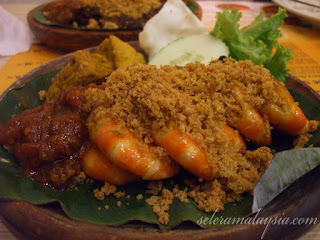
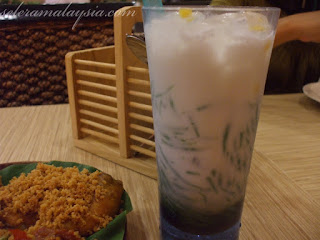
So, our order were two Ayam Penyet (smashed chicken), one Udang Penyet (smashed prawn), one Empal Penyet (smashed beef), Ice Cendol, Teh tarik, and two Laici Cincau with total of RM57.60. The food was delicious with quick service and nice environment. I definitely will be back for more.

Udang PenyetIce Cendol

Categories:

Ikan Patin Tempoyak at Akob Patin House


It is located by the Kuantan riverside, behind the old KWSP office and the old Samudera Hotel building. Opening Hours : Lunch only, get there around 12pm or it'll be tough to get seats.


Akob Patin House serves an array of Malay dishes which you'd take with white rice. Among its usual servings are rebung masak lemak, veggies, beef and fish dishes. It is self service style. This is a popular place and the lunch crowd numbers can be high.


The speciality of Akob Patin House is .. duuhhh.... patin la, what else. The patin is cooked in tempoyak style, and there are usually 2 types which are Patin Sangkar and Patin Buah, the latter being more expensive. The gravy is "thickish" and the aroma and taste of tempoyak is very prominent, making your drool on the expectation of savoring the fish itself.


This would be my typical dish here. A plate of white rice, some tempoyak made of fresh durians (you can actually taste the durian sweetness), sambal tempoyak and mangga and some veggies, coupled with a piece of patin masak tempoyak. Oh, and a teh 'o' ais laici.. heaven....


Another specialty here is the Ikan Kerai Goreng, which you need a good bit of time to eat as it has small bones that you need to pick out. The v shaped bones are hell if you get one stuck in your throat, so be careful. The time spent to eat this fish is worth it, though. Our total bill for 4 persons came close to RM50. Money well spent, I'd say.

Categories:

Mar 26, 2010

Kuih gula bakar & Kuih Telinga Keling

Hitam2 Pun Sodapp!

Aisheh, I don't have to waste time making my own Malai Kou la. The Saturday Kelana Jaya pasar tani sells my favorite kuih gula bakar. One big piece for RM2 only. Yum yum!


The side view. See all the air holes. So nice.


Back view even nicer. Just love the kuih!

I must learn how to make this one day. But first thing is to learn how to cook the sugar properly. Cooking the gula bakar needs a lot of time and skills with the fire control... something which I don't have hehe.


Anyway, I bought this too. Meneram? Merenam? I forgot the name of this quih but I kind of like it too.


It's gula melaka with a flour mixture deep fried in cold then heated hot oil.


Dad don't like it because it doesn't taste like dough nut. Imagine crushed dhall beans with gula melaka then deep fried... something like that. A bit sandy texture.


One big happy family.


Inside the meneram. Nyummm2x!

Categories:

Ayam Percik

Nyummmmm....Chicken!

This is the 'true' Malaysian-styled barbequed chicken. Percik is directly translated as 'splash', let me tell you why in a few seconds. The marinade is made fresh, from local herbs that is then blended and cooked alongwith the chicken, before barbequing the chicken. And percik, or 'splash', is because as we barbeque the chicken, we splash or splatter more marinade onto the chicken to thicken the flavour. The result is perfectly barbequed chicken, moist and very tasty - capturing all the herbs that's blended and combined with the meat.

The origins of Ayam Percik is believed to come from Kelantan, a beautiful state in the northern East-Coast of Peninsular Malaysia. Like many other local Kelantan delicacies, this recipe uses a lot of fresh local herbs and spices as the key ingredients. Chillies, Lemongrass, Galangal, Ginger, and Onions, amongst others, when blended and cooked, brings a rich and aromatic flavour that I simply drool over.

Some of the ingredients that I use to make Ayam Percik. These ingredients are also called in many other local traditional food such as Rendang, Curries, and more. I would say that these are the basic 'must-have' ingredients for cooking the Malaysian way! Easily available in the local market here in Malaysia, or in Asian grocery stores.

I normally have my hands full to shoot photos of the 'making of' my foods, but today, thanks to my kind husband, F, he managed to take a few shots while I was busy in the kitchen :-)

Cooking this takes a few hours for me, thanks to my small kitchen, no griller or bbq pit, and the fact that it is my first time making it in a very, very long time... but it was all worth my time and effort - F loved it so much! :-)

:: Ayam Percik Recipe ::


Chicken pieces
(I used 8 chicken thighs)
50 grams fresh santan
(coconut milk) (or substitute with plain yogurt or some milk)
2 tablespoon of tamarind juice
(or sunstitute with 1 tablespon lemon juice)

Ingredients to make the paste:
10 shallots
3 garlic cloves
2cm fresh ginger
2cm fresh galangal (it's ok not to have this)
2 lemongrass stalk (bottom part)
2 tablespoon chili paste (or substitute with fresh red or green chilis)
1 teaspoon turmeric powder
1 teaspoon salt
1 tablespoon brown sugar
1 teaspoon belacan (dried shrimp paste) (optional)
1 cup water

1. Cut the ginger, galangal and lemongrass into small pieces (simply to ease the blending process) and blend all the ingredients ina food processor until smooth. This will be the key paste used as the chicken marinade, and the only thing you need now to cook the chicken.

2. Marinate the meat with the blended paste for 30 minutes or more. Meanwhile, cook some rice and cut some fresh cucumber to serve with the chicken :-)

3. Heat a large wok and cook the chicken with the paste, over a medium heat until gravy thickens, about 10-15 minutes and separate the meat from the percik gravy.

4. Barbeque/grill/bake the chicken pieces, splashing some gravy over the meat. Turn the chicken and splash more gravy until it thickens and the chicken start to cook (you can see darkened spots on the chicken).

5. Serve fresh from the heat and have a little extra gravy on the side for that extra dipping, trust me, you'll love it!

Nice to eat on its own, for lunch or when you have a party, and usually served with rice - I personally like it with plain rice or briyani :-)

What does it taste like? Close to satay, I'd say, but without the peanut sauce. I like my percik to be spicy and not too sweet. Many sold out there tend to be on the sweet side, but I prefer the gravy to be thick and always have a small bowl of extra gravy for my tastebuds :-)


Categories:

Jeruk Penang

Maiiii.....maiiii singgah dulu

Hubby, youngest boy and I have an hour to kill because my two other sons have sports practice at SXI. So we head over to Esplanade around 5.30 pm. As it was almost dinner time, I told him about the Mee Sotong. I found a stall, ate and found that it is not as good as what others mentioned. I found out later that I went to the wrong stall. Never mind, I will go back again tomorrow for lunch, as revenge.

jeruk penang

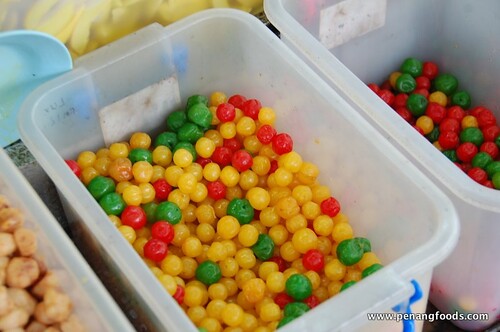
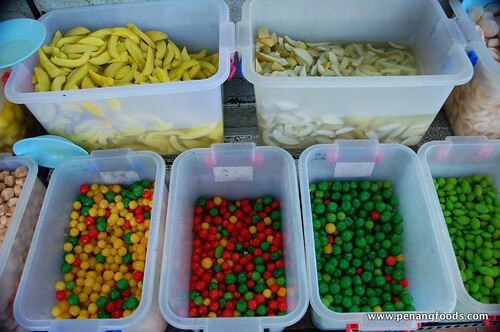
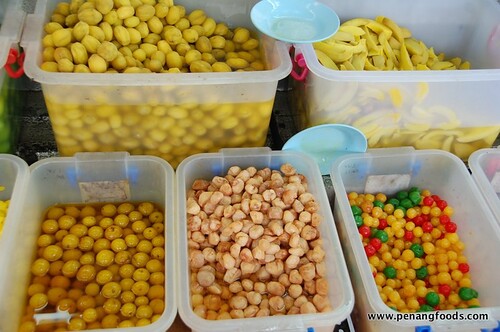
There aren’t many stalls opened at that hour. However, this colourful jeruk or pickled fruits caught my eyes. OMG, look at those colourings! I bet you will get stomach cancer if you eat that often. The pickles sourish smell does make me salivate and the fruit inviting colours make me want to pop one into my mouth.

jeruk penang

However, I do not want to die of rotting stomach so I didn’t touch those colourful pickles. I wonder if those people who pickled these fruits have any idea how safe are the colourings they use?

jeruk penang

Some of these pickles are undeniably very tasty especially the mangoes. But I think these food producers should have some heart and not poison others to death with the kind of colourings and chemicals they use.

So, ladies, especially if you are pregnant or planning to conceive, please stay away from all these pickled fruits because they contain not only harmful colourings but other preservatives and sweeteners. Some of those sweeteners may cause deformities in fetuses. Remember that these pickled fruits look good, kills even faster.

Categories:

Mar 25, 2010

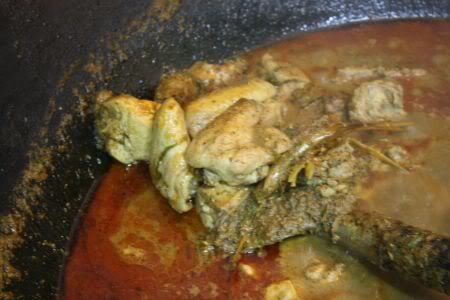
Rendang Tok

Rendang Tok @ Warung Rendang Kak Yong, Giant Shah Alam

sublime melt in the mouth rendang tok

A very quick one for today! Been quite busy with work hence I've not been exploring much but we did recently discover this little gem in Giant Shah Alam. Around the food court (don't eat the hotplate noodles, tastes yucky with the starchy sauce!), there's also small stalls fringing the food court that sell all kinds of food like rojak, beef soups, cold drinks, popiah, nasi lemak and this particular stall specialising in various types of rendang. You can opt to eat the spicy rendang with yellow glutinous rice (pulut kuning), roti jala, ketupat or nasi impit (compressed rice).

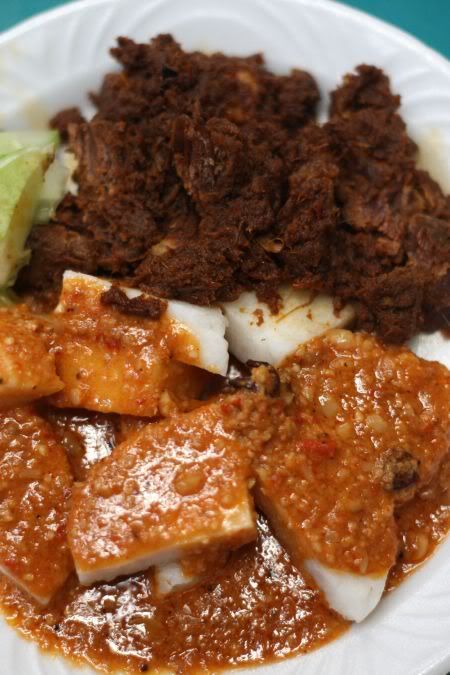
my hefty plate of rendang tok with nasi impit drizzled with peanut sauce (RM5.50)

I've always loved rendang tok with its dark brown fork tender beef chunks with a slightly sweetish taste. Usually cooked until dry for many hours in coconut milk, this rendang is said to originate from Perak. Not usually found everywhere here, this stall's version is excellent and priced reasonably as a plate of rendang tok with compressed rice (nasi impit) drizzled with peanut sauce is RM5.50.

Aside from rendang tok, she also sells rendang ayam (but it is more like a watery rich coconut milk curry with chicken pieces), rendang kerang, rendang paru paru and etc. We're still discovering what else is good in her stall but I definitely won't mind returning here to pack some rendang tok and ketupat from her, if I have friends over or when it is Raya.

Categories:

Lemang Pak Ali (Warisan)

@ Jalan AU5, Lembah Keramat, Kuala Lumpur


take your pick from all that lemang in various sizes

I'm back! Had a good break even though it was a super hectic schedule. Been suffering from minor jetlag....hence, no blogging yet until this week. Plus, I haven't been doing anything exciting to blog about too.

cracking that bamboo open...

Keeping with the Raya theme, I thought I'll blog about lemang we had yesterday. Did a quick trip down to Lembah Keramat (not Keramat okay, as I got scolded by Splashie Boy for this wrong statement, since it meant him making a few wrong turns!) on Saturday night after work and managed to get the famous lemang.

so yummy and delish...one is never enough!

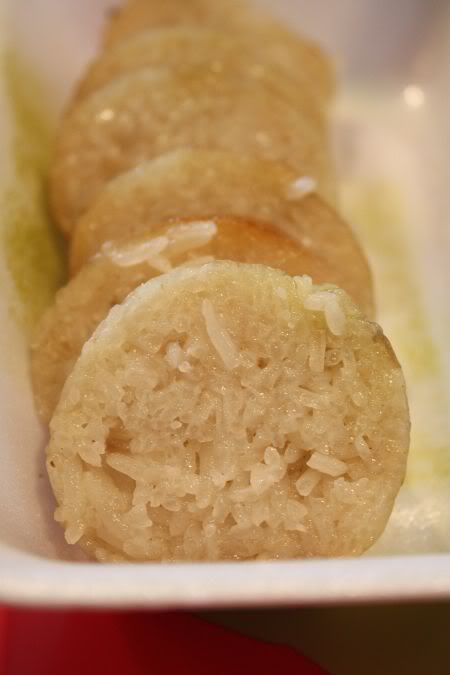
Popularly known as Lemang Pak Ali, even though the card says Lemang Warisan, there is a cute signboard at the house they operate at, proclaiming them to be the "Lord of the Lemang". What makes their lemang special, according to an article I read before, is they use wild banana leaves to wrap the lemang. Usually, you can get kinda dissapointed with lemang - bits of uncooked rice and hard bits within, but this lemang was perfect. Soft and aromatic, everyone couldn't stop eating it for lunch yesterday.

gulai kawah...cooked in a large wok

To accompany the lemang, we had bought a portion of almost black colour rendang tok. Sadly to say, the pictures of it didn't turn out well but the rendang tok was super yummy. A bit spicy from all the pepper used but very tender and delicious, that one still continues to eat even though it burns your tongue. There's also gulai ayam (as seen above cooking in a large kawah aka the wok), serunding, home made cookies and ketupat daun palas at the place.

Copyright © JommJalan | Powered by Blogger